What Attendees Actually Remember in 2026
By Blink Design Studio | April 2026
Here’s something every event manager already feels but rarely says out loud: most trade show booths are forgettable.
Not bad. Not ugly. Just… unmemorable. A logo on a back wall, a counter with brochures, a screen playing a corporate video on loop. Attendees walk through, collect a card, and by the time they reach the next aisle, your brand has already faded.
In 2026, that’s not a design problem. It’s a business problem. The exhibit industry is going through its most significant shift in decades. The era of static displays is over. The brands winning on the show floor aren’t the ones with the biggest budgets — they’re the ones creating experiences that attendees can’t stop talking about.
The Multisensory Shift: What the Research Shows
The science behind experiential booth design is well-documented. According to research cited by Exhibit Options and multiple experiential marketing studies, multisensory engagement increases brand recall by up to 10x compared to visual-only exposure (Exhibit Options, 2025). Harvard Business Review research on sensory marketing has demonstrated that engaging multiple senses creates stronger, more durable memory traces.
The numbers from the field confirm this:
91% of consumers feel more positive about a brand after a live, interactive experience (ATN Event Staffing, 2025). 74% of attendees are more likely to purchase after a hands-on booth experience. And 70% report higher brand recall from experiential engagement compared to digital advertising alone (Kande Photo Booths, 2026).
It’s no longer enough to look good. The question is: what does your booth feel like?
Consider what the Trouw Nutrition booth achieved at IPPE 2026. Walking into their space, visitors were surrounded by hanging plants, a living green wall, natural wood textures, and warm ambient lighting. The booth didn’t just display products — it created an atmosphere that embodied their sustainability mission. Attendees stayed longer, engaged deeper, and remembered the experience weeks later.
Or take Peru’s pavilion at IMEX Las Vegas. The design team created a signature AV activation with mirrored surfaces and synchronized audio that immersed visitors in Peru’s landscapes. You didn’t just see Peru — you heard it, felt the space shift around you, and walked away with a visceral memory.
Designing for What Attendees Actually Do
The mindset around booth design is shifting. For 2026, it’s less about flashy visuals and more about genuine interaction. When attendees say they want an “immersive” experience, they mean getting to try something, touch it, or engage with it.
This is backed by data: 46% of attendees spend 15–30 minutes engaging with exhibits that offer interactive elements (Kande Photo Booths, 2026). Dwell time has increased by 12% year-over-year thanks to the adoption of immersive formats including gamification, AR, and live demonstrations (Art and Display, 2025).
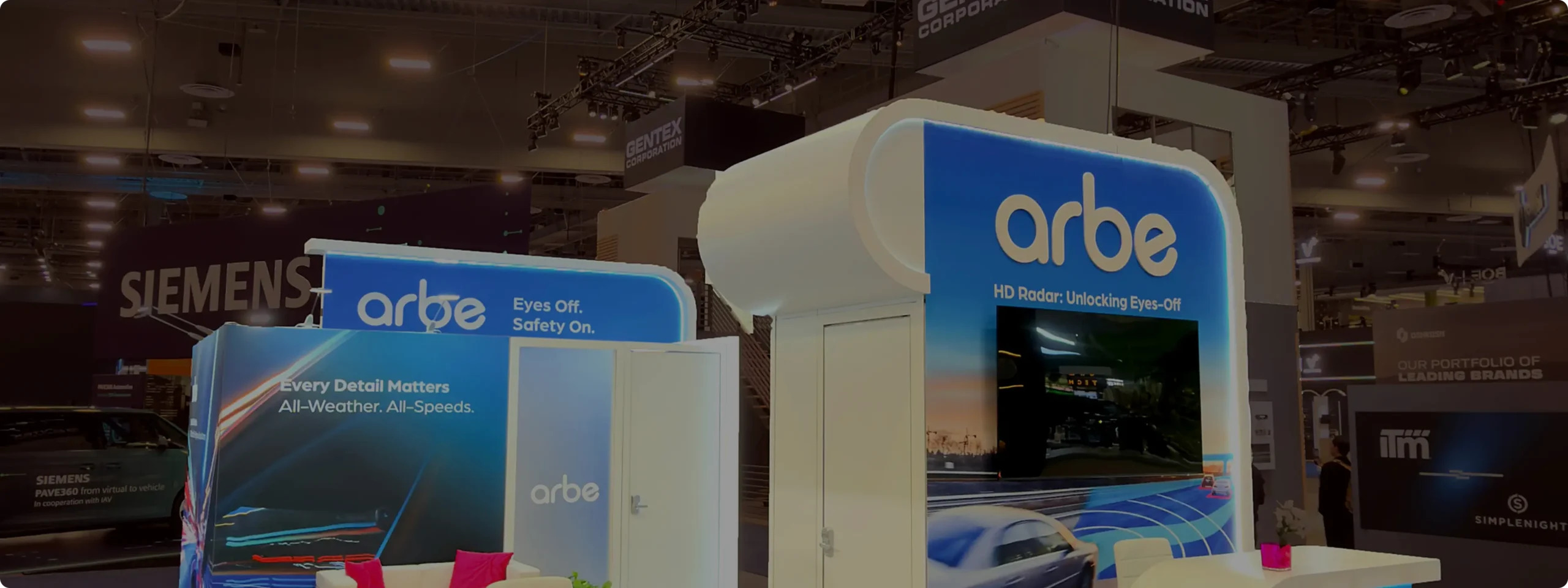
Demo stations beat demo videos. At CES 2026, Arbe’s booth ran four live radar demonstration stations simultaneously. Visitors didn’t watch a screen explaining 4D imaging technology — they stood in front of a working system and saw it in action. The result: 30+ scheduled buyer meetings and a private meeting room booked solid for three days.
Product interaction drives conversion. At GlassBuild Americas, Cortizo’s booth featured operational windows and sliding doors built into custom walls. Architects didn’t look at product photos — they opened, closed, and tested full-size samples on the spot. That hands-on format was the single biggest differentiator on the show floor.
Themed environments tell stories that brochures can’t. At Seatrade Cruise Miami, the St. Maarten booth transported attendees to the Caribbean through turquoise color palettes, oversized beach photography, wooden accents, and resort-style lounge furniture. Cruise line executives didn’t need a PowerPoint about the destination — they were already in it.
The Photo-Op Economy: Free Media with a Physical Footprint
There’s a metric that doesn’t show up in most ROI calculations but drives enormous value: attendee-generated content.
When someone photographs themselves at your booth and shares it on LinkedIn or Instagram, your brand reaches an audience you never paid for. That organic reach compounds. According to research from PG Exhibits and Cvent, nearly 72% of event attendees actively capture and share content online, with Instagram, YouTube, and Facebook as the top platforms (Cvent, 2026; PG Exhibits, 2025). 78% of exhibitors consider social media a powerful channel to showcase their trade show activities.
The brands that understand this design for shareability. INABA Churu’s Times Square activation was engineered entirely around this principle — a 20-ft cat-ear portal, a Hollywood-style red carpet with a branded walk of fame, and a golden cat statue photo stage. In a location with 330,000+ daily foot traffic, every element was built to make people stop, photograph, and share.
This isn’t vanity design. It’s a media strategy with a physical footprint.
The same principle works at trade shows. A living wall, an oversized product replica, a dramatically lit brand moment — these elements cost a fraction of your total booth budget but can generate more impressions than your entire digital advertising spend for the quarter.
Technology as a Layer, Not the Headline
AI adoption among event planners has jumped significantly, with 50% of marketers planning to use AI to create tailored, personalized experiences for attendees by 2025–2026 (Art and Display, 2025). But the smartest exhibitors are using technology as a layer within the experience — not as the experience itself.
LED integration, interactive touchscreens, RFID-triggered personalization, and spatial audio all work best when they enhance a well-designed physical space. A booth that relies on screens alone feels cold. A booth that uses technology to amplify a warm, human environment feels sophisticated.
More sophisticated use of data gathered pre-show or in real-time via badge scans and interactive kiosks is being used to deliver customized content and tailored demonstration paths (Taylor Corporation, 2026). The trend toward kinetic LED architecture — walls and ceilings that move and respond — is exciting, but it only works when it serves the brand story.
Technology should answer the question: what do we want the visitor to feel? If the answer is “impressed by our screens,” you’ve missed the point.
What This Means for Your Next Show
If you’re an event manager or marketing director planning a 2026 or 2027 exhibit, here’s the shift to internalize:
Design around visitor behavior, not your org chart. Most booths are laid out like corporate websites — product A here, product B there, meeting rooms in the back. The best booths are designed like retail stores: entrance moments, discovery zones, and clear paths that guide visitors toward engagement.
Invest in one unforgettable element. You don’t need every part of your booth to be extraordinary. You need one moment that no one else on the floor has. A living wall. An AV activation. An operational product demo. An oversized photo-op. That single element becomes the thing people remember — and talk about.
Make it easy to share. Good lighting, a clean background, and a reason to take a photo. These details cost almost nothing but create outsized value. If an attendee can’t get a good photo at your booth, you’re leaving free media on the table.
Engage more senses. Sound, texture, scent, and spatial design all contribute to memory formation. Humans recall smells with 65% accuracy even after a year (Exhibit Options, 2025). A booth that feels different — not just looks different — stays with visitors long after the show ends.
The Booths That Win in 2026
The exhibit industry is evolving fast. Static displays are losing ground to experiential environments. Passive logo walls are being replaced by interactive brand stories. And the exhibitors who treat their booth as a three-day experience — not a three-day billboard — are seeing measurably better results.
The show floor is the last marketing channel where your customer comes to you. Make the experience worth the trip.
Ready to design an exhibit that attendees actually remember?
We create immersive trade show experiences — from AV activations to biophilic environments to hands-on product showcases — engineered for engagement, shareability, and ROI.
Blink Design Studio — We Always Go Further.